Europe’s €500 Billion Fashion Market: Why Marketplaces Are Becoming the Next Growth Channel for Brands
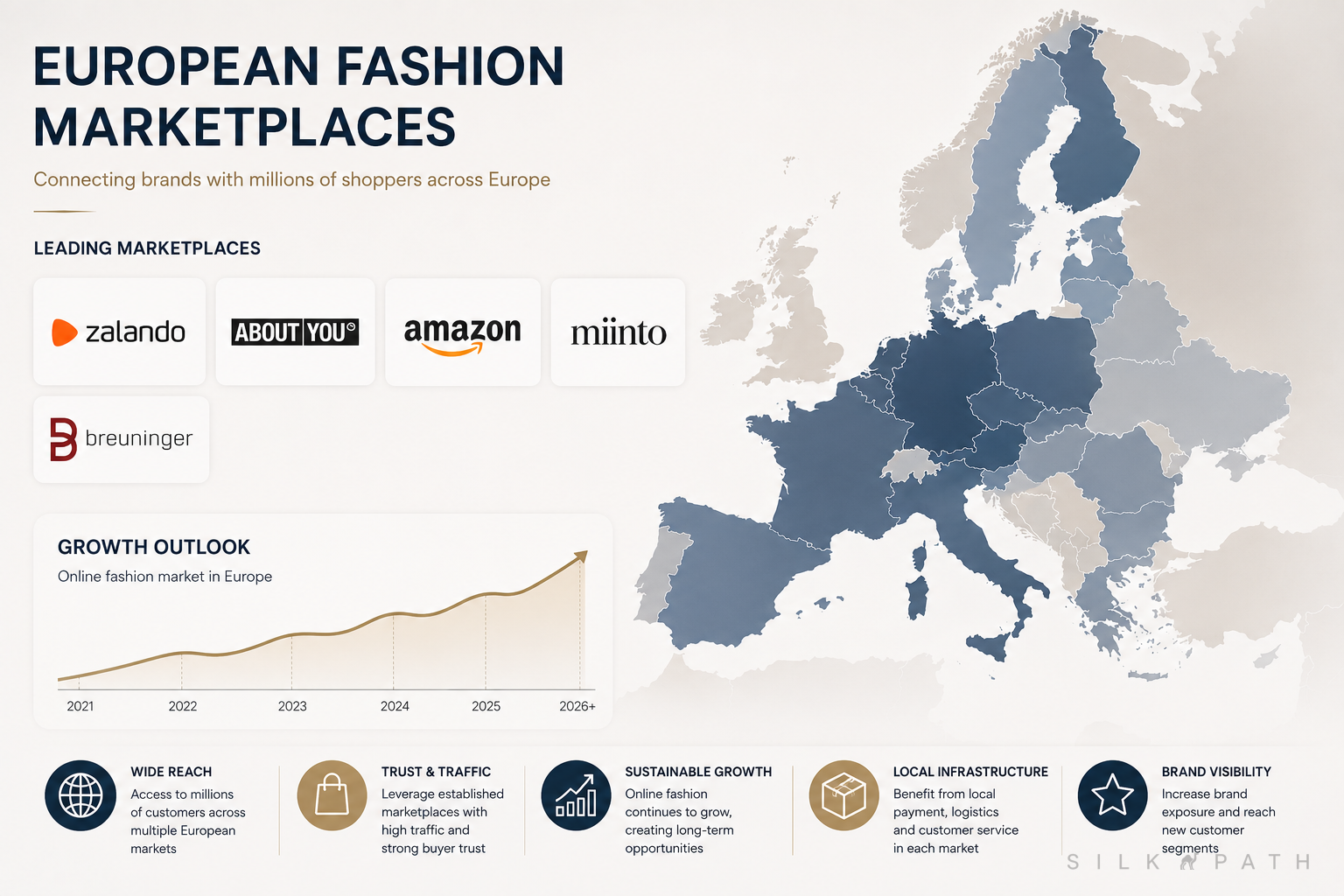
Europe remains one of the world’s largest fashion markets, generating approximately €500 billion in annual sales. Despite economic uncertainty and increasing competition, consumer demand for fashion continues to grow, while shopping behavior is changing faster than ever.
SILKPATH Market Insight
There is no universal answer. A marketplace may be an excellent growth channel for one brand and an expensive distraction for another.
What has changed is the role marketplaces play. They are no longer treated simply as another place to list products. For many brands, they are becoming part of a broader international expansion strategy.
A multi-channel model is becoming the norm
A few years ago, many fashion companies concentrated most of their attention on launching a strong D2C store and acquiring customers through digital advertising.
Today, the more resilient businesses tend to combine several channels, with each one serving a different purpose.
- Direct-to-Consumer Customer relationships, brand control and first-party data.
- Physical retail Visibility, trust and direct product experience.
- Wholesale through agencies and distributors Wider distribution through established commercial networks.
- European marketplaces Access to existing demand across several markets.
Marketplaces do not have to replace D2C, retail or wholesale. In many cases, their value lies in helping a brand reach customers who would not otherwise discover its own store.
“Marketplaces do not replace the brand’s existing business. Their value is in accelerating access to markets the brand has not yet reached.”
SILKPATH market observation
International expansion without building everything from zero
Entering a new European country independently requires more than translating a website. A brand must consider local acquisition costs, payment preferences, customer service, delivery expectations and returns.
A marketplace can remove part of that initial friction. It provides access to customer traffic, an established shopping environment and infrastructure that already operates across several countries.
What we are seeing
Brands now ask fewer questions about whether integration is technically possible. They ask more questions about profitability, positioning, logistics and the right marketplace for their product category.
Integration is usually not the hardest part
A common assumption is that connecting systems will be the main challenge. In practice, technical integration is only one part of the project.
The more difficult questions usually appear earlier:
- Is the product competitive? The offer must be strong relative to its segment, price and quality.
- Is the content convincing? Images and descriptions should communicate the real strengths and details of the product.
- Can the margin support the channel? Commissions, shipping, marketing and returns must still leave a viable commercial result.
- Can operations scale? Inventory, warehousing, production and order processing need reliable automation.
- Are logistics competitive? Strong carrier contracts and predictable delivery costs matter from the first order.
- Is the marketplace a good fit? A platform’s audience, geography and category structure should match the brand.
Key takeaway
Brands rarely struggle because a marketplace connection cannot be built. More often, the real issue is that pricing, product presentation, logistics or margins were not prepared for marketplace competition.
AI is changing product presentation — for better and for worse
AI has made fashion content faster and less expensive to produce. Brands can now create campaign concepts, adapt visuals for different markets and test alternative product presentations without organising a full photoshoot for every variation.
Used well, this can reduce production costs and improve conversion.
But there is a clear risk. When an AI-generated image makes a material, colour, silhouette or fit look better than it does in reality, the customer receives a promise the product may not fulfil.
The result can be more returns, weaker ratings and higher operational costs.
In our view, the strongest brands will not be those producing the most impressive AI visuals. They will be those using AI to present the product more clearly without misrepresenting it.
“Zalando is evolving from a retailer to a retail enabler for the entire fashion and lifestyle industry.”
Zalando Annual Press Conference
That statement says a great deal about where the market is heading. Marketplaces are investing not only in retail, but also in data, logistics, personalisation, product discovery and infrastructure for brands.
A marketplace is a business channel, not a one-time project
Going live is only the beginning. Long-term results depend on assortment, pricing, stock availability, content quality, ratings, delivery performance and continued optimisation.
This is why marketplace expansion should not be treated as a one-off technical connection. It should be managed as a separate commercial channel with its own economics, targets and operating processes.
Final thought
The next phase of European fashion growth will not necessarily belong to the brands with the largest marketing budgets.
It is more likely to favour brands that combine a strong product, competitive margins, convincing content, efficient operations and a clear multi-channel strategy.
The important question is therefore not simply whether a brand should enter a marketplace.
The real question is which marketplaces offer a genuine commercial opportunity for that particular brand — and whether the business is ready to operate there profitably.
SILKPATH Assessment
Brand Marketplace Opportunity Assessment
We evaluate a brand’s expansion potential across leading European fashion marketplaces based on its product category, pricing, competitive positioning, content, logistics and operational readiness.
- Marketplace fit by platform
- Competitor and price positioning
- Category and product opportunities
- Margin and return-risk considerations
- Product content and visual presentation
- Operational and logistics readiness
- Recommended priorities for expansion